• Scammers begin sending out fake DocuSign emails to instill trust, harvest personal information

    Scammers begin sending out fake DocuSign emails to instill trust, harvest personal information

    If you get a random DocuSign email out of nowhere from someone you don’t know, don’t sign it.

    Per AppleInsider, scammers have begun sending fake DocuSign emails that appear to show charges from major companies, including Apple, in an attempt to catch users off guard. Some of the messages look like billing receipts for recent Apple Pay purchases, with the emails claiming a subscription has been charged to your account and includes a phone number to call if it wasn’t you.

    As such, don’t call the number or click on any links within the email, as this will connect you to scammers posing as support agents. These messages also use Apple’s branding and are framed as DocuSign alerts, complete with a fake order ID, a charge total, and language meant to create urgency. The entire setup is designed to get you to react quickly and call. The purported orders can be for something recognizable, such as a Netflix subscription, with the email stating that the payment went through Apple Pay and that a document is ready to view on DocuSign.

    The email may include a security code to “access” the file, which helps make it look more official. That alone is a red flag, and another is the support number, which often appears as “1-804-390-9231.”

    The sender name may also contain odd characters, like a Cyrillic “B” in “Billing,” to evade spam filters and make the email harder to block.

    The scam itself works by prompting the user to call a company that the user believes is Apple’s support division or a support division from a trustworthy company. Once on the phone, the purported representative might ask for personal details, passwords, or remote access to your device. Some demand payment to “secure” your account. Once access is gained, they can lock you out, steal information, or initiate fraudulent transactions.

    These scams can often be spotted by checking for the following details:

    • The sender isn’t from an official company domain.
    • The receipt is delivered through DocuSign, which Apple, Netflix and others, don’t use.
    • The message creates artificial urgency to push you into calling.
    • The support number isn’t listed on the company’s website.
    • The charge doesn’t show up in your App Store or Wallet history.

    Always remember that legitimate billing emails won’t ask you to call a phone number. If something seems off, log into your Apple ID and check recent transactions in the Settings app on your devices.

    The cool cats at AppleInsider have also published the following tips to avoid support scams:

    • If you get one of these emails, don’t click anything or call the number. Delete the message and report it.
    • To report Apple-related scams, forward the email to [email protected]. If the message came through DocuSign, send it to [email protected].
    • To verify any real charges, open the App Store or Wallet app on your device. You can also check your account directly at support.apple.com.
    • Scammers often target Apple users because of the trust built around Apple services and branding. Combining that with DocuSign, which is commonly used for secure documents, makes the scam more believable.
    • Email from Apple discussing an invoice and Docusign process, including instructions and links. Displayed on an iPad screen with signal and battery indicators.

    As always, be careful out there, and if something feels off, don’t hesitate to delete the email. Speaking from personal experience, these people will never stop, and it costs them next to nothing to send out millions of scam emails every day. Be prepared for what’s out there, don’t call the phone numbers, and you should be ok.

    Via AppleInsider

  • Apple patent points towards company’s development of a next-generation image sensor

    Apple patent points towards company’s development of a next-generation image sensor

    When in doubt, go with in-house research and development until you get something exactly the way you want it.

    According to a recently published Apple patent, Apple is moving forward with plans to bring a new type of image sensor with dynamic range levels approaching that of the human eye to next-gen iPhones.

    Per a leak on Weibo, last month, Apple filed a patent titled “Image Sensor With Stacked Pixels Having High Dynamic Range And Low Noise.” It described an advanced sensor architecture that combines stacked silicon, multiple levels of light capture, and on-chip noise suppression mechanisms to reach up to 20 stops of dynamic range.

    The dynamic range of the human eye is estimated to be around 20 to 30 stops, with this varying as to how the pupil adjusts and how light is processed over time. The majority of smartphone cameras today can capture between 10 and 13 stops, and Apple’s sensor could potentially surpass current iPhones but also outperform many professional cinema cameras, such as the ARRI ALEXA 35.

    The patent outlined a stacked sensor design made up of two layers. The top layer, called the sensor die, contains the parts that capture light. The layer underneath, the logic die, handles processing, including noise reduction and exposure control.

    Per MacRumors:

    “One of the most important parts of the sensor design is a system called a Lateral Overflow Integration Capacitor (LOFIC). This allows each pixel in the sensor to store different amounts of light depending on how bright the scene is, all in the same image. With this, the sensor can handle extremely wide lighting differences, such as a person standing in front of a bright window, without losing detail in the shadows or highlights.

    Another part of the design focuses on reducing image noise and grain. Each pixel has its own built-in memory circuit that measures and cancels out heat-related electronic noise in real time. This is done on the chip itself, before the image is saved or edited by software.”

    The Weibo leaker, known as “Fixed Focus Digital,” has stated that the project is more than merely a patent filing at Apple, and that the company has already developed the sensor and could now be testing it in developmental hardware, suggesting that there are plans to bring it to a consumer device in the future.

    Apple currently uses sensors manufactured by Sony for its iPhone lineup. These sensors incorporate a two-layer design, while Apple’s proposed version would include several original features and occupy less space. Such a move would give Apple even more control over its hardware and follow similar moves away from using hardware from companies like Intel and Qualcomm in favor of its own custom technology.

    Stay tuned for additional details as they become available.

    Via MacRumors, USPTO, and Fixed Focus Digital

  • Apple posts $94 billion in revenue, $23.4 billion profit for Q3 2025

    Apple posts $94 billion in revenue, $23.4 billion profit for Q3 2025

    Apple was able to beat analysts’ predictions with its third quarter 2025 financial results on Thursday, posting revenue of $94.0 billion, a 10 percent year-over-year increase. The company reported $23.4 billion in profit.

    Analysts had predicted revenue of under $90 billion, which Apple comfortably beat by 6 percent.

    The iPhone led the company’s revenue with $44.5 billion, a 13.5 percent increase over the Q3 2024. Apple’s Services division saw a boost of $3 billion year-over-year, boosting it to another quarterly record. Mac sales were also up nearly 15 percent.

    The iPad division generated $6.6, but saw a 7 percent reduction in the year-over-year from Q3 2024. Apple updated the iPad Pro with M4 chips in May, but the iPad Pro is a low-volume product. Apple’s more affordable tablets were refreshed earlier this year: iPad Air was updated in March with an M3 chip, along with the A16-equipped 11th-generation iPad.

    The company’s Wearables, Home, and Accessories divisions saw an 8.6 percent decrease in the year-over-year. This category is mainly bolstered by AirPods and Apple Watch, both of which are due to get updates this fall.

    The financials sttod as follows:

    • iPhone: $44.6 billion (up from $39.3 billion)
    • iPad: $6.6 billion (down from $7.2 billion)
    • Mac: $8 billion (up from $7 billion)
    • Wearables, Home, and Accessories: $7.4 billion (down from $8.1 billion)
    • Services: $27 billion (up from $24 billion)

    Stay tuned for additional details as they become available.

    Via Macworld

  • Hitman: Absolution en route to iPhone and iPad for this fall

    Hitman: Absolution en route to iPhone and iPad for this fall

    If you’re hankering for “Hitman” goodness on your iPhone or iPad, you only have a few months to wait.

    IO Interactive and Square Enx have announced that Hitman: Absolution will be arriving on the iPhone and iPad this fall.

    In Hitman: Absolution, players reprise their role as Agent 47. Assigned to kill his former handler, the mission takes a turn when the fate of a teenage girl rests squarely on 47’s shoulders. The story finds Agent 47 defying the agency he once worked for and being declared a traitor, the game serving as a direct sequel to Hitman: Blood Money Reprisal, which landed on iOS and iPadOS in November 2023.

    In the game, players can choose between stealthy kills or going in guns blazing, adapting their approach to each mission. Instinct Mode helps track targets and anticipate enemy movements, while Point Shooting allows rapid takedowns. Hitman: Absolution also supports both touchscreen controls as well as keyboard and mouse setups and gamepads.

    Hitman: Absolution is available for preorder now at a presale price is $14.99, is projected to release on September 25, and will require a device with an A12 Bionic chip or later, as well as a device running iOS 18 or iPadOS 18 or later.

    Stay tuned for additional details as they become available.

    Via AppleInsider and the App Store

  • At least 30 airlines now allow for luggage tracking via iOS’ Find My feature

    At least 30 airlines now allow for luggage tracking via iOS’ Find My feature

    It’s never easy to fly, but this could help.

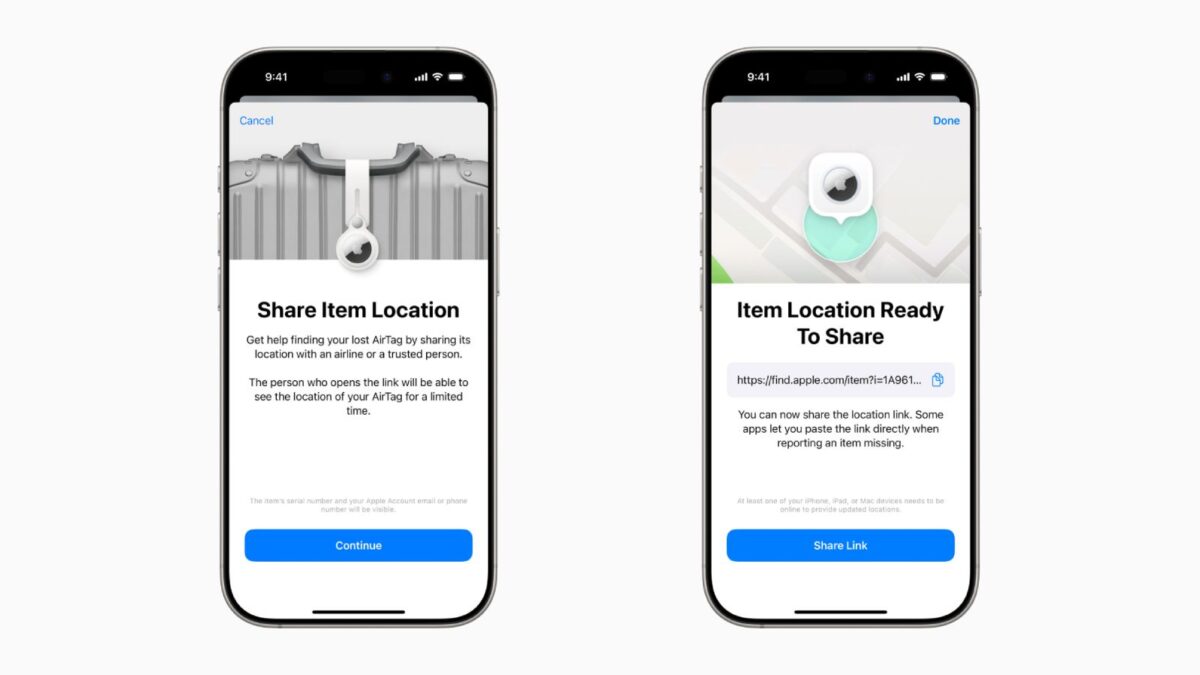
    Back in December, Apple released iOS 18.2 with a new feature in the Find My app that allows you to temporarily share the location of an AirTag-equipped item with others, including employees at participating airlines. This way, if you have put AirTags inside your bags, the airline can better help you find them in the event they are lost or delayed at the airport.

    The feature also works with other item trackers that support the Find My network, such as products sold by Chipolo and Pebblebee. As such, iPhone, iPad, and Mac users running iOS 18.2, iPadOS 18.2, and macOS Sequoia 15.2 or later can generate a “Share Item Location” link in the Find My app. From there, they can share a link that allows them to view the item’s location on a map and automatically updates with the item’s latest location. The item’s location stops being shared “as soon as a user is reunited with their item,” or automatically expires after seven days.

    The following is a list of aidlines that currently support the feature:

    • AJet
    • Aer Lingus
    • Air Canada
    • Air France
    • Air India
    • Air New Zealand
    • American Airlines
    • Austrian Airlines
    • Breeze Airways
    • British Airways
    • Brussels Airlines
    • Cathay Pacific
    • China Airlines
    • Delta
    • Eurowings
    • Finnair
    • Iberia
    • JetBlue
    • KLM
    • Lufthansa
    • Porter Airlines
    • Qantas
    • Saudia
    • Singapore Airlines
    • SunExpress
    • SWISS
    • Turkish Airlines
    • United
    • Virgin Atlantic
    • Vueling

    There may be others that offer support for the feature, and if you’ve heard anything, please let us know in the comments.

    Via MacRumors