Tag: M2

  • WWDC: Apple announces second-generation Mac Studio featuring M2 Max, M2 Ultra processors

    WWDC: Apple announces second-generation Mac Studio featuring M2 Max, M2 Ultra processors

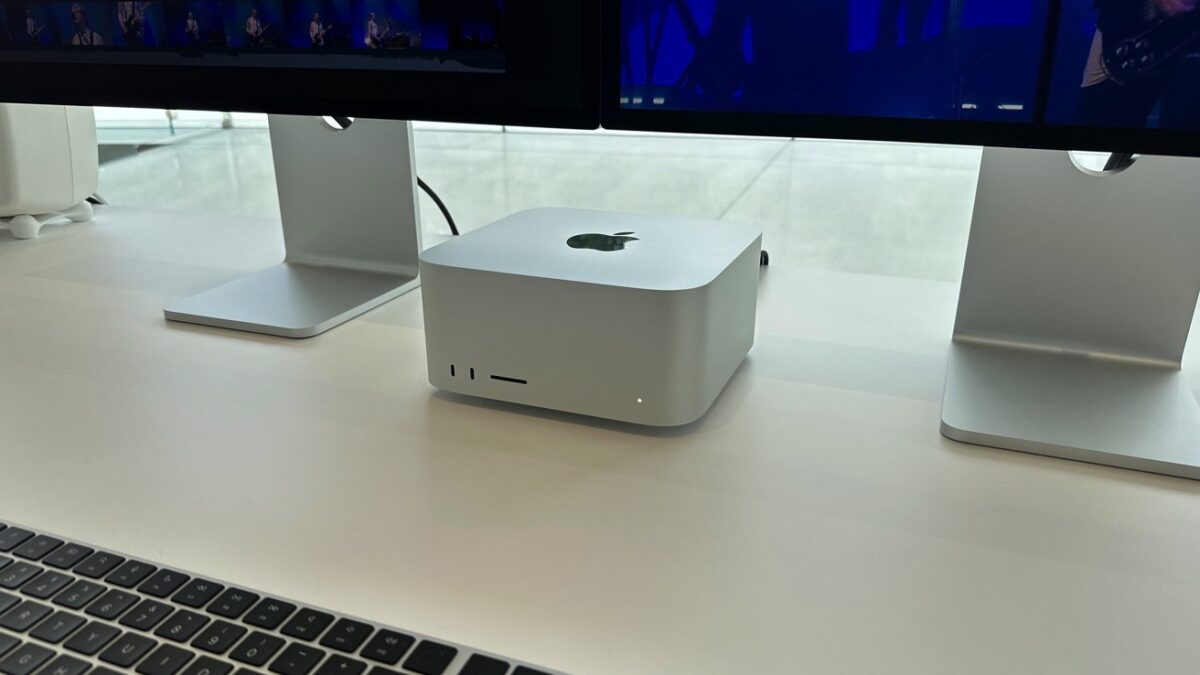
    Over at WWDC on Monday, Apple announces its second-generation Mac Studio desktop, complete with M2 processors offering up to 25 percent fast performance while retaining the same chassis as the first-generation model.

    The original Mac Studio was released in March 2022 in configurations with an M1 Max or an M1 Ultra processor. This new refresh offers a choice of M2 Max and M2 Ultra processors.

    According to Apple, the unit “doubles the performance of M2 Macs. The 24-core CPU and M2 Ultra delivers 20 percent faster performance than M1 Ultra, and its 76-core GPU is 30 percent faster than M1 Ultra. Finally, the 32-core neural engine is 40 percent faster.”

    The M2 Ultra “can support an enormous 192GB of unified memory, which is 50 percent more than M1 Ultra.”

    The new Mac Studio with M2 Max “now has higher-bandwidth HDMI,” says Apple, “enabling up to 8K resolution and 240Hz frame rates.” Per the company, with the M2 Ultra, Mac Studio can drive up to six Pro Display XDRs. It also comes with Wi-Fi 6E, and Bluetooth 5.3 connectivity.

    The new Mac Studio, which retails from $1,99, became available for pre-orders on Monday with shipping beginning next week.

    Stay tuned for additional details as they become available.

    Via AppleInsider

  • WWDC: Apple unveils Vision Pro headset, cites early 2024 release date, offers AR preview of device

    WWDC: Apple unveils Vision Pro headset, cites early 2024 release date, offers AR preview of device

    It’s been the subject of rumors and whispered about for years, and Apple finally brought it to the stage on Monday during the WWDC 2023 keynote. Apple’s Vision Pro headset, its first mixed-reality headset device, finally exists and is powered by visionOS, the company’s new operating system for the device.

    Apple describes the Vision Pro headset as “a revolutionary spatial computer that seamlessly blends digital content with the physical world.” The device features an all-new operating system that features a three-dimensional interface. Experiences in Vision Pro aren’t constrained to the boundaries of a display, users can make apps at any scale, and place apps wherever they wish. Users use a combination of their eyes, hands, and voice to control the device.

    The headset starts at a $3,499 price point and will be available in early 2024. It will be available in Apple retail stores in the U.S. only.

    The headset itself will be made of polished glass that flows into a lightweight aluminum frame. The unit also features a button and a Digital Crown that lets a user control how present or immersed they are in an environment.

    The headset has a modular system to achieve an optimal fit. Its battery is separate and links via a magnetic connection to the side of the headset.

    The Vision Pro incorporates a wide array of cameras and sensors that combine the physical world with digital content. The Light Seal, which connects to the user’s face, is made of a soft textile, and comes in a range of shapes and sizes, flexing to conform to a user’s face for a precise fit. A series of flexible straps ensure audio remains close to the user’s ears, while a Head Band, which is available in multiple sizes, is three-dimensionally knitted as a single piece to provide cushioning, breathability, and stretch. The band is secured with a simple mechanism, making it easy to change to another size or style of band.

    For users wearing glasses, a set of magnetic prescription ZEISS glass inserts must be used with the Vision Pro headset.

    The hardware itself features an ultra-high-resolution display system with 23 million pixels across two micro-OLED displays – more than a 4K for TV for each eye. A group of high-speed cameras combines with a ring of LEDs that project invisible light patterns onto the user’s eyes to track gaze. The headset also contains the M2 chip paired with a new “R1” chip, dedicated toward real-time sensor processing. The unit is powered by a unique dual-chip M2 system, while the new R1 chip processes input data from 12 cameras, five sensors, and six microphones to ensure that content feels like it is appearing right in front of the user’s eyes, in real-time. The R1 processor streams new images to the displays within 12 milliseconds. The entire headset is designed for all-day use when plugged in, and up to two hours of use with its external, high-performance battery.

    From an acoustic perspective, the device uses a new Spatial Audio system with two individually amplified drivers inside each audio pod, which delivers Personalized Spatial Audio based on the user’s own head and ear geometry. It can match the sound to an environment using audio ray-tracing.

    The headset can be controlled by a user’s eyes, hands, and voice, and users can browse through apps by simply looking at them, tapping their fingers to select, flicking their wrist to scroll, or using voice to dictate. It also supports Apple’s Magic Keyboard and Magic Trackpad devices. The unit also offers passthrough video of a wearer’s eye via a feature known as “EyeSight,” which displays the user’s eyes to surrounding people. It uses a lenticular OLED display to show the correct perspective to anyone viewing the wearer.

    Other neat features include Environments, which allows users to connect to their Mac and expand its display in a virtual space, including alongside apps running on Vision Pro itself. The device’s Optic ID feature uses a wearer’s iris to authenticate users and unlock the Vision Pro headset. Vision Pro is also “Apple’s first 3D camera,” showing depth in video with Spatial Audio.

    For developers, the visionOS can import iPhone and iPad apps to run on the vision device. A new App Store segment will also be built to discover apps built for visionOS as well as compatible ‌iPhone‌ and ‌iPad‌ apps.

    Other interesting tidbits include the Vision Pro’s age requirement, which is for users 13 years and older. It’s unknown how Apple might enforce this.

    Vision correct accessories are sold separately, Apple says, which should explain the $3499 starting price. However, and this is a big but, Apple adds that “not all prescriptions are supported.”

    Finally, Apple has published a hardware preview of Vision AR for the iPhone and iPad. While this isn’t the equivalent of a hands-on demo, it’ll give you an idea of what to expect should you snag one next year.

    Stay tuned for additional details as they become available.

    Via MacRumors, 9to5Mac, and Apple
  • No Man’s Sky launches for the Mac via Steam, Mac App Store release coming soon

    No Man’s Sky launches for the Mac via Steam, Mac App Store release coming soon

    While it’s unconfirmed as to whether it might be headed to Apple’s forthcoming headset, the classic action-adventure survival game “No Man’s Sky” is now available for the Mac on Steam, with “another surprise” from studio Hello Games to follow in the “near future.”

    Following last year’s WWDC announcement, Hello Games announced that No Man’s Sky would be available for the iPad and Mac would by the end of 2022. While Hello Games missed that deadline, the game is finally available for the Mac as of Thursday. Hello Games founder Sean Murray teased two upcoming Apple-related announcements earlier this week. Today, Murray seemingly confirmed that the launch for Mac is one of the two teased announcements, meaning another is soon to follow.

    No Man’s Sky is currently available on multiple VR platforms, including the Windows PC and PlayStation VR. When the game was demoed at WWDC last year, it was played on a Mac with the M1 chip. Since Apple’s headset is rumored to feature at least one chip that is based on the M2 chip in addition to a dedicated image signal processor, it should be more than capable of running the game.

    No Man’s Sky is available for the Mac now on Steam and retails for $59.99, with a release on the Mac App Store to soon follow. The game also offers a cross-play feature, which tracks the progress of the game and your campaigns across platforms.

    Stay tuned for additional details as they become available.

    Via MacRumors and Steam

  • Gurman hints at multiple new and updated Macs to be launched at WWDC 2023

    Gurman hints at multiple new and updated Macs to be launched at WWDC 2023

    There’s no stopping the rumor mill, especially this close to WWDC 2023.

    Per Bloomberg’s Mark Gurman, a number of new and updated Macs are expected to debut alongside Apple’s anticipated AR headset.

    Following the discovery of three unknown desktop Mac models in Apple’s Find My code, Gurman predicts an extended WWDC will concentrate on hardware.

    In a recent tweet, Gurman offered the following expectations:

    I’m expecting three major focus areas next week: 1) several new Macs, 2) the mixed-reality headset, and 3) the new OSs. With all of the new hardware and software, I expect the keynote to be one of Apple’s longest ever and easily exceed two hours.

    — Mark Gurman (@markgurman) May 31, 2023

    Gurman did not identify exactly how many Macs to expect but has previously claimed that Macs with Apple’s M3 next-generation processor won’t launch before the end of 2023. As such, anything launched will likely remain with some variant of the M2 processor.

    Rumors have focused on an expected 15-inch MacBook Air as part of the WWDC lineup. It seems unlikely that the 14-inch MacBook Pro or the 16-inch MacBook Pro will be updated, as those both had revisions earlier in 2023.

    As of April 2023, Gurman had predicted that neither an updated Mac Studio nor a New Mac Pro would be seen at WWDC. He’s recently suggested that the Mac Studio may be refreshed, as Apple will begin taking trade-ins for the Mac Studio from the day WWDC begins.

    Apple’s week-long WWDC for software developers starts with a keynote on Monday, June 5, 2023. That presentation will be streamed live.

    Stay tuned for additional details as they become available.

    Via AppleInsider and @MarkGurman

  • Hello Games founder posts cryptic tweet, hints at possible launch for Apple platforms for No Man’s Sky

    Hello Games founder posts cryptic tweet, hints at possible launch for Apple platforms for No Man’s Sky

    An absolutely amazing game has been teased for Apple’s platforms.

    The founder of Hello Games, the makers of popular action-adventure survival game “No Man’s Sky,” yesterday tweeted two apple emojis, sparking speculation that the studio is teasing an announcement for Apple platforms at WWDC.

    Hello Games founder Sean Murray, who’s been known to tease upcoming announcements via cryptic emojis, teased that No Man’s Sky would be available for the iPad and Mac would by the end of 2022. Hello Games missed that deadline and the game has yet to release for Apple devices, meaning that the two emoji teasers could indicate that the launch of No Man’s Sky for the ‌iPad‌ and Mac is now imminent.

    It’s also rumored that given the widespread energy and hype around Apple’s mixed-reality headset at WWDC in less than a week, No Man’s Sky could be en route for the new device. No Man’s Sky is already available on multiple VR platforms, including on PC and PlayStation VR. When the game was demoed at WWDC last year, it was played on a Mac with the M1 chip. Since Apple’s headset is rumored to feature at least one chip that is based on the M2 chip in addition to a dedicated image signal processor, it should be more than capable of running the game.

    Hello Games has also worked with Apple to publish games on Apple Arcade, something which points to a solid connection and/or relationship between the two companies.

    Stay tuned for additional details as they become available.

    Via MacRumors and @NoMansSky