Tag: RGB

  • Apple announces updated Studio Display, Studio Display XDR monitors

    Apple announces updated Studio Display, Studio Display XDR monitors

    If you’ve been hankering for Apple’s updated Studio Display monitors, they’re about here.

    Apple has announced the next-gen Studio Display XDR, which features a 27-inch 5K Retina XDR display with 5120-by-2880 resolution, a 120Hz refresh rate, and more.

    Here are the specs of the Studio Display XDR:

    • 27-inch (diagonal) 5K Retina XDR display
    • 5120-by-2880 resolution at 218 pixels per inch
    • Mini-LED backlight with 2304 dimming zones
    • Up to 1000 nits brightness (SDR)
    • 2000 nits pea brightness (HDR)
    • 120Hz refresh rate and Adaptive Sync
    • Support for 1 billion colors
    • P3 + Adobe RGB wide color gamuts
    • True Tone technology

    The Studio Display XDR has a 12MP Center Stage camera and supports Desk View. This is accompanied by a six-speaker system with Spatial Audio support and a three-mic array for “studio-quality” recording.

    The display also offers the following ports:

    • One upstream Thunderbolt 5 port for host (with 140W host charging)
    • One downstream Thunderbolt 5 port for connecting high-speed accessories or daisy-chaining additional displays
    • Two USB-C ports (up to 10Gb/s)

    The overall design of the Studio Display XDR is basically identical to the standard Studio Display. For instance, it does not carry over the iconic lattice pattern from the Pro Display XDR.

    The new Studio Display with a tilt-adjutable stand starts at $1,500, while the Studio Display XDR with a tilt and height-adjustable stand starts at $3,299. Both units are available in standard or nano-texture glass options, and have been available for pre-order since Wednesday. The units will be available for retial purchase on Wednesday, March 11.

    Stay tuned for additional details as they become available.
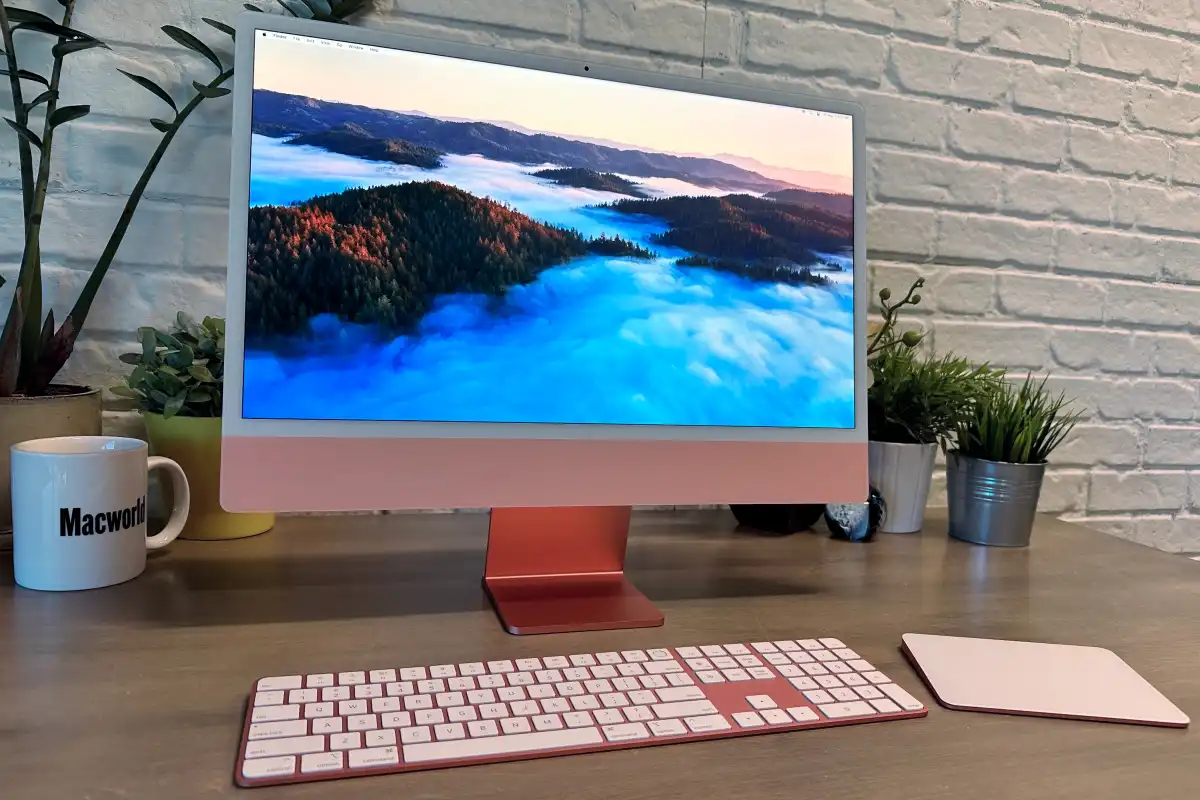
    Via 9to5Mac and Apple

  • Rumor: Apple working with Samsung to develop display for a 24-inch OLED iMac

    Rumor: Apple working with Samsung to develop display for a 24-inch OLED iMac

    You’ve been hankering for an Apple Silicon iMac for years with larger than a 21-inch screen, and Apple may be developing it.

    According to The Elec, Apple has placed “Requests for Information” with Samsung Display and LG Display regarding OLED displays that could be used for a future iMac.

    “Requests for Information,” or “RFI,” are basically when a company asks suppliers to provide specifications and other details as to a component the company needs for product development. In this case, Apple has stated in its requests that it is looking for a 24-inch OLED display that offers 218 pixels per inch density and 600 nits of brightness. This is roughly the same size and density as Apple’s current LED-based iMac display, albeit with higher brightness.

    Unfortunately, the article also points out that “RGB OLED technology capable of reliably mass-producing 20- to 30-inch displays has not yet been developed.” In this case, mass production has become successful for smaller OLED displays, and a supplier would need to develop a process to mass produce the larger displays, which could take some time.

    The Elect reports that Apple could complete development of the OLED iMac by 2027 or 2028. If everything goes as scheduled, the OLED iMac would ship in 2027 at the earliest should development finish in the early part of the year. It could also be more likely that the larger-display iMac would become available in 2028 or 2029. There’s also the possibility that Apple could scrap the project during its development stage.

    Apple has been gradually migrating its devices from LED displays to OLED, its current iPhone lineup using OLDs, which the iPad Pro stands as the only iPad to use an OLED. Reports have also said that Apple plans to release an OLED touchscreen MacBook Pro in the second half of 2026.

    Stay tuned for additional details as they become available.

    Via Macworld and The Elec

  • Rumor: Second-gen Apple Vision Pro to feature brighter display components, will be released in 2027

    Rumor: Second-gen Apple Vision Pro to feature brighter display components, will be released in 2027

    The second-generation version of the Apple Vision Pro headset could feature a brighter, more efficient RGB OLEDoS display set to release in 2027.

    The existing Apple Vision Pro set to release in early 2024 uses white OLED plus color filter displays (WOLED+CF). Passing light through a separate filter reduces the amount of brightness available in the final picture.

    According to a new supply chain report, from Omdia Outlook provided by The Elec, Apple will shift to the better RGB OLED on Silicon (OLEDoS) in 2027. In RGB OLEDoS, RGB subpixels produce both light and color, so there isn’t any need for a color filter — preserving the overall brightness.

    Apple currently contracts with Sony for its WOLED+CF displays, which may limit how many Apple Vision Pro units can be shipped. The report indicates that RGB OLEDoS doesn’t have much of a supply chain either, with Samsung owning the only company producing panels today, which are used by the US military.

    The 2027 timeframe for Apple Vision Pro 2 lines up with what was previously reported by Ming-Chi Kuo. A low-cost headset was due in 2025, but that may have been canceled entirely as Apple waits for technologies like OLEDoS to improve on its initial product.

    Stay tuned for additional details as they become available.

    Via AppleInsider and The Elec

  • iFixit video highlights “surprisingly easy” HomePod disassembly and repair

    iFixit video highlights “surprisingly easy” HomePod disassembly and repair

    The cool cats at iFixit have delivered the goods again, this time with a new teardown video demonstrating the surprisingly easy process in taking Apple’s new HomePod smart speaker apart. The new process is a significant step up from the original 2018 HomePod, which required sawing, cutting, and a big mess to get inside. The 2023 model has proven to be much more simple to disassemble, thanks to less adhesive throughout.

    The updated unit can now be easily accessed by removing a few screws and using some leverage to remove the upper cap housing the logic board.

    When disassembled, the bottom of the logic board revealed the S7 processor borrowed from the Apple Watch Series 7, and the top shows a series of small RGB LEDs that produce the swirling colors under the top glass.

    The center half of the HomePod is dedicated to the main 4-inch woofer, which actuates 20mm during playback. Under that is the amplifier board, then deeper still are the five tweeters.

    The audio amplifier features a giant heat sink, which iFixit explained is used to ensure temperatures remain low during use. This is also due to temperature’s ability to affect audio. Per the video, the humidity and temperature detector found in the base of the HomePod is identical to the one found in the HomePod mini.

    If you’ve had a chance to delve into the innards of the updated HomePod, please let us know about your experience in the comments.

    Via AppleInsider and iFixit

  • Rumor: Apple to offer OLED 12.9-inch iPad for late 2023 or early 2024

    Rumor: Apple to offer OLED 12.9-inch iPad for late 2023 or early 2024

    Apple could be looking at an OLED 12.9-inch iPad for either late 2023 or early 2024.

    Following a reported breakdown between Apple and Samsung in their OLED iPad relationship, LG is said to be offering the technology for a 12.9-inch iPad in the future.

    Per The Elec and a rumor from a South Korean supply chain supplier, Apple’s 12.9-inch iPad Pro could see a big revision in a few years. Specifically, a new technology for OLED screen production will lead to a brighter and longer-lived display than existing screens.

    The report stated that LG is developing “two stack tandem technology” for the iPad. This would entail two layers of RGB emission equipment, which could increase the brightness of the screen as well as its life given the presence of additional backups for burnt-out sub pixels.

    While Samsung remains the main screen supplier for the 2021 iPhone lineup, LG has stepped in as an additional supplier for the iPhone 13 OLED display. Samsung is said to be impacted by Apple’s plan to cancel a 10.9-inch OLED iPad Air refresh.

    Apple has been rumored to shift to OLED displays for the MacBook Pro and iPad Pro lines for some time. Despite the iPad Air reporting recently, Samsung is still expected to be Apple’s primary supplier of OLED screens.

    Stay tuned for additional details as they become available.

    Via AppleInsider and The Elec